Thought this was interesting. It shouldn't be difficult for Amazon to make the next version of their Kindle DX accessible to the blind!
11/11/2009
FOR IMMEDIATE RELEASE
Baltimore, Maryland (November 11, 2009): The National Federation of the Blind, the oldest and largest organization of blind Americans, today applauded the decision of the University of Wisconsin-Madison and Syracuse University to not deploy Amazon’s Kindle DX as a means of distributing electronic textbooks (e-books) to their students. The Kindle DX features text-to-speech technology that can read textbooks aloud. The menus of the device are not accessible to the blind, however, making it impossible for a blind user to purchase books from Amazon’s Kindle store, select a book to read, activate the text-to-speech feature, and use the advanced reading functions available on the Kindle DX. Both universities have experimented with the Kindle DX to learn whether e-book technology is useful to their students. But the schools will not adopt the device for general use unless and until it is made accessible to blind students.
Dr. Marc Maurer, President of the National Federation of the Blind, said: “The National Federation of the Blind commends the University of Wisconsin-Madison and Syracuse University for rejecting broad deployment of the Kindle DX in its current form because it cannot be used by blind students and therefore denies the blind equal access to electronic textbooks. We do not oppose electronic textbooks; in fact, they hold great promise for blind students if they are accessible. But as long as the interface of the Kindle DX is inaccessible to the blind—denying blind students access to electronic textbooks or the advanced features available to read and annotate them—it is our position that no university should consider this device to be a viable e-book solution for its students.”
The University of Wisconsin-Madison experimented with e-books for assigned course reading in an upper-level history seminar and encouraged students to give feedback about their experiences using e-books. Ken Frazier, the university’s director of libraries, said of the Kindle: "The big disappointment was learning that the Kindle DX is not accessible to the blind. Advancements in text-to-speech technology have created a market opportunity for an e-book reading device that is fully accessible for everyone. This version of the Kindle e-book reader missed the mark. It is relatively easy to envision an improved e-book reading device that meets the needs of the entire university community. Such a device would include universal design for accessibility, higher-quality graphics, and improved navigation and note-taking. I think that there will be a huge payoff for the company that creates a truly universal e-book reader."
Pamela McLaughlin, director of communications and external relations at Syracuse University, said: “The university purchased two Kindle DX devices to learn whether they might be an appropriate means of distributing textbooks and course materials. Students are experimenting with these devices so that we can learn more about the advantages and disadvantages of this technology. At this time, however, we have no plans to purchase any more of these units in light of the fact that they are inaccessible to blind students. If Syracuse University decides to use e-book technology on campus, we will require technology that can be used by all of our students, including those who are blind.”
###
About the National Federation of the Blind
With more than 50,000 members, the National Federation of the Blind is the largest and most influential membership organization of blind people in the United States. The NFB improves blind people’s lives through advocacy, education, research, technology, and programs encouraging independence and self-confidence. It is the leading force in the blindness field today and the voice of the nation's blind. In January 2004 the NFB opened the National Federation of the Blind Jernigan Institute, the first research and training center in the United States for the blind led by the blind. Please visit our Web site: www.nfb.org.
CONTACT:
Chris Danielsen
Director of Public Relations
National Federation of the Blind
(410) 659-9314, extension 2330
(410) 262-1281 (Cell)
cdanielsen@nfb.org
Universities Will Not Deploy Kindle DX as Textbook Reader
National Federation of the Blind Commends Schools
for Demanding Accessibility for Blind Students
Thursday, November 12, 2009


Monday, May 4, 2009
Crop engineering could solve world's malnutrition and protect eyesight
A multivitamin for the world's poor could be found in a cup of corn meal. Scientists in Spain have engineered African lines of white corn to provide high levels of beta carotene, a key source of vitamin A, a nutrient critical to protecting eyesight.
The grain, which has an orange tint because of the beta-carotene, also contains significant levels of vitamin C and folate. Less than a cup of the corn could provide the recommended daily intake of vitamin A, scientists reported in the Proceedings of the National Academy of Sciences. Researchers said the achievement "opens the way for the development of nutritionally complete" grains.
read the full article at Clarion Ledger
The grain, which has an orange tint because of the beta-carotene, also contains significant levels of vitamin C and folate. Less than a cup of the corn could provide the recommended daily intake of vitamin A, scientists reported in the Proceedings of the National Academy of Sciences. Researchers said the achievement "opens the way for the development of nutritionally complete" grains.
read the full article at Clarion Ledger
River blindness persists in Africa | GlobalPost
Health officials battle to combat 'forgotten disease' that leaves many villagers blind.
MNGAZI, Tanzania — A man with clouded eyes sits on the ground next to a wattle and daube hut in the riverside village of Mngazi. His five children mill around and his wife tends a pot over a wooden fire. He used to be a corn farmer, but then his eyes started itching three years ago.
Now, he is totally blind and cannot work. He does not know what happened, nor is he the only villager whose vision began to disappear. He said he went to a witchdoctor, but it did not help.
The man's blindness is not a result of magic, but a small worm that invaded his body. He is one of 37 million people worldwide, most of them in sub-Saharan Africa, suffering from onchocerciasis, commonly known as river blindness.
Read more... River blindness persists in Africa | GlobalPost
Thursday, April 30, 2009
Looking challenges in the eye
Here's a great article I ran into about a woman who is blind and runs four companies!
http://www.deccanherald.com/Content/Apr252009/she20090424132174.asp
http://www.deccanherald.com/Content/Apr252009/she20090424132174.asp
Friday, March 13, 2009
Beyond the mind's eye
20 years after Elizabeth Goldring, a senior fellow at MIT's Center for Advanced Visual Studies and colleagues began work on a "seeing machine," she smiles as she shows a visitor photos she's taken - and can see - with her blind eye.
http://web.mit.edu/newsoffice/2009/camera-blind-0113.html
http://web.mit.edu/newsoffice/
Wednesday, March 11, 2009
Matt Steven can't see the hoop. But he'll still take the last shot.
A friend just passed along a truly amazing story about Matt Stevens, a blind boy from Upper Darby, PA who not only shoots the free-throws for his sighted high school basketball team, but also makes half of the shots. That makes him one of the best free-throwers on the team!
Read more about Matt Stevens here
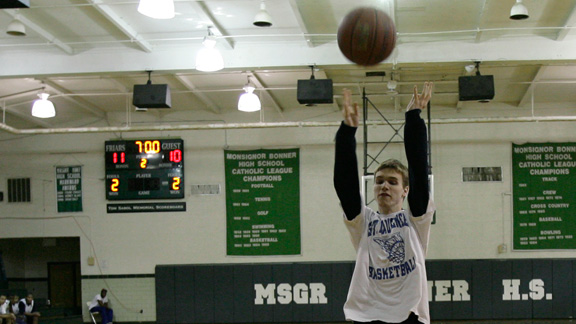
Read more about Matt Stevens here
Blind team attempt to set new record on Kilimanjaro
As reported by ABC news in this article, a team of eight blind climbers are set to climb Kilimanjaro later this month - potentially setting a new record for the most blind climbers on the summit at once - as part of the 'High Sight Expedition'. The record is still held by the 2005 climb, organized by Erik Weihenmayer, that led to the formation of the Kilimanjaro Blind Trust. Read more about the most recent attempt to set a new record here.


Monday, February 23, 2009
Google Engineer Adapts Cell Phone for Blind
By SUNITA SOHRABJI
indiawest.com February 19, 2009 02:10:00 PM
How functional would your cell phone be if you couldn’t see its numbers?
For many blind users, including Google engineer T.V. Raman, the small keyboards of a cell phone can be daunting.
So Raman is developing software to adapt T Mobile’s G1 touchscreen phone — which uses Google’s Android software — to make it friendlier for blind people and others with limited vision, such as the elderly.
“The small keyboard of a cell phone is not easy to use, particularly if you need one hand free,” Raman told India-West in a telephone interview from Google headquarters in Mountain View, Calif. The blind generally need one hand free to hold a guide dog.
Read more here
indiawest.com February 19, 2009 02:10:00 PM
How functional would your cell phone be if you couldn’t see its numbers?
For many blind users, including Google engineer T.V. Raman, the small keyboards of a cell phone can be daunting.
So Raman is developing software to adapt T Mobile’s G1 touchscreen phone — which uses Google’s Android software — to make it friendlier for blind people and others with limited vision, such as the elderly.
“The small keyboard of a cell phone is not easy to use, particularly if you need one hand free,” Raman told India-West in a telephone interview from Google headquarters in Mountain View, Calif. The blind generally need one hand free to hold a guide dog.
Read more here
Wednesday, January 7, 2009
Louise Braille Turns 200
To celebrate Louise Braille's 200th birthday last weekend, PRI The world released an interesting short on his legacy. Listen to it at PRIs website.
Happy Birthday Louise!
Happy Birthday Louise!
Subscribe to:
Posts (Atom)

 Posts
Posts

